
Flexi FD Vs Regular FD
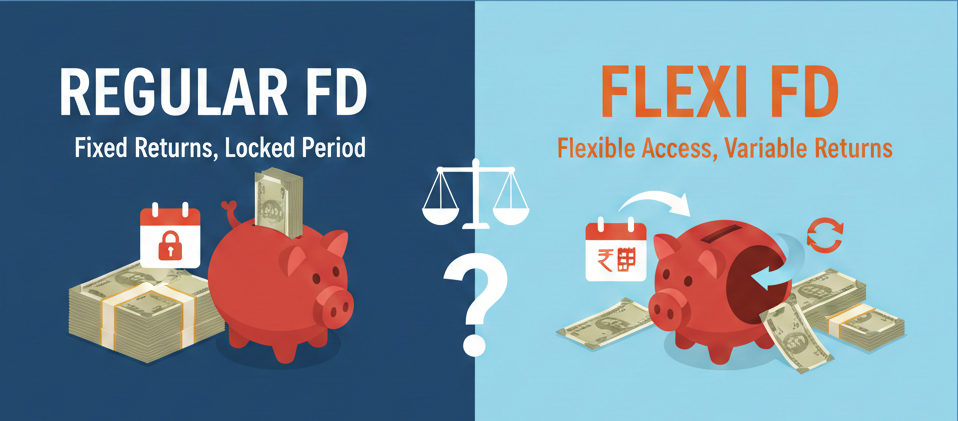
To invest your hard-earned money so that it can grow over time and also beat the inflation, one can look for a variety of investment options such as equity, real-estate, bonds, fixed deposits, etc. Many of these investment options do come with risk but the fixed deposits are considered to be the safest and simplest of them with a guaranteed return.
Fixed deposits are not the new thing; it has been around for almost more than 100 years in India. It was first introduced by the British government in the early 1900s to promote savings, which gradually went through different structural changes over time. Recently, with the evolving demand of customer’s financial preferences, banks have started offering the flexi FDs, which is an alternative to regular FDs but with more flexibility. In this article, we will explore the key differences between regular FDs and flexi FDs and which option suits you well. If you also invest in mutual funds - use our SIP calculator to find out the future value at the time of retirement.
What is a Fixed Deposit (FD) ?
A fixed deposit is a term deposit scheme offered by banks or financial institutions where you deposit a lump sum of money for a fixed period of time on which you receive a guaranteed regular interest at a predetermined rate by the bank or the financial institution. Unlike savings accounts, the interest earned on FDs is slightly higher. Regular FDs are often used by customers to meet their long-term financial goals.
Key Features of FD
- Fixed tenure - customers can choose the deposit tenure between as short as 7 days to as long as 10 years.
- Fixed interest rate - during the entire tenure, the interest on the deposits are fixed.
- Guaranteed return - You are assured of the maturity amount that you are going to receive after the completion of tenure.
- Risk Covered - The amount deposited in fixed deposit is insured up to Rs 5 Lakhs per depositor per bank under the Deposit Insurance and Credit Guarantee Corporation (DICGC) scheme.
- Interest Payout Option - Customers have the option to receive the interest monthly, quarterly, yearly, or at the end of tenure.
- Premature Withdrawal - Customers can withdraw money anytime prematurely during the financial need, but it comes with reduced interest rate or little penalty.
What is a Flexi Fixed Deposit (Flexi FD)?
Flexi FD is the hybrid of a savings account and a fixed deposit account. It combines the features of both of them. The main idea behind Flexi FD is to utilize the idle funds in the savings accounts to earn more interest like FD without locking it.
Key Features Of Flexi FD
- Auto Sweep In - In flexi FD, when the balance in your savings account exceeds the predetermined threshold value, the extra amount is automatically transferred into fixed deposits.
- Auto sweep Out - When the balance in your savings account falls below the threshold predetermined amount, the funds are automatically restored from the FD amount to maintain the minimum threshold balance in the savings account.
- Flexible Interest - The funds that are swept in FD earn the interest rate as FD for the duration it remains there. As a result, your money earns higher interest in comparison to a savings account with easy accessibility during the need.
Comparison Between Regular FD and Flexi FD
Regular FD and Flexi FD both serve different financial needs. Regular FDs are preferred more for parking the fund for a longer term, whereas flexi FDs are more liquid in nature where money can be withdrawn anytime and the threshold amount can also be adjusted. Hence, flexi FD offers more flexibility and freedom to the account holder. Let’s compare both of them to understand the major differences.
| Feature | Regular FD | Flexi FD |
|---|---|---|
| Liquidity | Less liquidity as premature withdrawal incurs penalty | More liquidity as a partial fund can be withdrawn from FD through reverse sweeping features without costing any penalties. |
| Interest rate | The interest rate on regular FD remains almost the same for the entire tenure. The FD rate is always higher than the savings account. | Remains similar to FD but may be impacted due to periodic withdrawal or due to the bank’s terms and conditions. Interest rate can be lower or not more than regular FD. |
| Flexibility | The FD terms do not change once it starts. | Interest and other terms might change from time to time. |
| Use Case | Suitable for long-term financial goals like education, wedding, retirement, etc where you do not require money in near future. | Suitable for periodic fund requirements that can be utilized from FD effortlessly. |
| Ease of management | FDs are manually managed. | Sweeping in and sweeping out of funds can be managed automatically. |
| Withdrawal | Funds can be withdrawn early but premature withdrawal incurs a penalty. | Funds can be withdrawn anytime and there is no penalty on sweeping in and sweeping out from FD. |
| Overall return | One can expect annualized return between 6-8 %. | Returns from Flexi FD can not be more than FD as net return can be influenced by periodic withdrawals. |
Disclaimer:
This article is for educational purposes only.The author or the website owner does not guarantee the correctness of the information provided here. Features and rules mentioned for regular FD and Flexi FD may change as per the bank’s policy or the RBI guideline. Please check the latest details from your bank before making any investment. Please consult a qualified financial advisor before making any investment decision.
Also read : SIP vs Lumpsum, FD vs Liquid Funds and FD vs Real Estate Investment
Published on : 08 Jan 2026